Proudly serving Phoenix, Glendale, Peoria, Scottsdale, Tempe, Mesa & surrounding areasCall or Text 24/7: +1 (480) 520-3949

Concrete Driveway, Patio, and Slab Construction Services in Goodyear, AZ

Phoenix Concrete Co. builds concrete driveways for homes and commercial properties in Goodyear, Arizona. Services include new driveway installation, repair, resurfacing, sealing, patios, slab-on-grade foundations, curb and gutter work, garage floors, and driveway aprons. Finish options include broom-finished, stamped, stained, colored, exposed aggregate, and polished concrete. Every project begins with a free concrete driveway estimate and a site review before work is scoped.

Goodyear's caliche-heavy soils can shift as moisture changes, while unshaded pavement temperatures regularly exceed 150 degrees. Those conditions can crack a poorly supported slab, accelerate surface curing, and wash out edge support during monsoon downpours. The crew adjusts base depth, mix design, pour timing, joint layout, and curing to suit the site instead of relying on a generic specification. That planning helps property owners choose between repair, resurfacing, and replacement with a clear understanding of the tradeoffs.

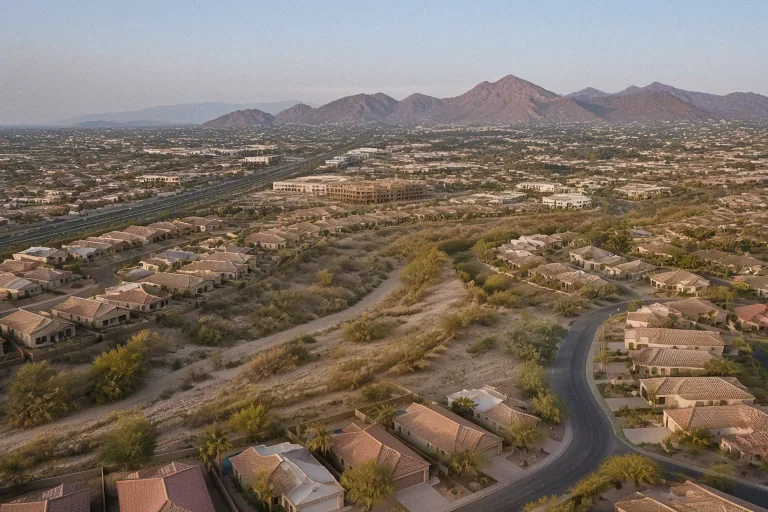
Service extends throughout Goodyear and the West Valley, including Estrella Mountain Ranch, PebbleCreek, Palm Valley, Canyon Trails, Sedella, the McDowell Road corridor, Litchfield Park, Avondale, and Buckeye. Goodyear grew from 95,294 residents in 2020 to an estimated 118,186 in 2024-roughly 23,000 more residents-adding substantial new-construction and replacement demand.

5-star rating4.9/5 Average Rating - 20+ Years of Experience - Goodyear Concrete Contractor Specialists - Residential & Commercial
Driveways & More

Concrete Services for Goodyear Properties

The service mix covers new construction, replacement, repair, maintenance, decorative finishes, and load-specific residential and commercial concrete. Selection starts with the slab's condition, expected loads, drainage, access, and the caliche below the base. Crews also handle comparable concrete work in Phoenix as part of the stated West Valley service area.

Concrete Driveways

Worker using a power trowel to smooth a wet concrete driveway at a residential jobsite in Goodyear, AZ.

Phoenix Concrete Co. coordinates driveway, patio, slab-on-grade foundation, curb and gutter, garage floor, driveway apron, resurfacing, and repair work. Available finishes include broom-finished, stamped, stained, colored, exposed aggregate, and polished concrete.

Explore Service

Concrete Patios

Worker using a power trowel to smooth a wet concrete patio at a jobsite in Goodyear, AZ.

Installation is handled as one coordinated sequence: excavation, forming, base compaction, reinforcement, placement, and finishing. When a project requires a permit, the company works through the City of Goodyear Building Safety Division and schedules inspections at the appropriate stages.

Explore Service

Concrete Slabs

Contractor operating a power trowel to smooth a wet concrete slab at a jobsite in Goodyear, AZ.

Hairline driveway cracks can be routed and filled with polyurethane or epoxy injection. Where spalling or heaving has progressed too far for a patch, damaged sections can be saw-cut and replaced after the underlying support is evaluated.

Explore Service

Concrete Foundations

Steel rebar cage and wooden formwork for a concrete foundation at a jobsite in Goodyear, AZ.

Maintenance combines surface cleaning, prompt treatment of oil or fertilizer stains, crack evaluation after monsoon season, and sealer renewal. Penetrating and film-forming products are selected to reduce water intrusion, UV degradation, and color-coat chalking.

Concrete Sidewalks

Worker using a power trowel to finish a fresh concrete sidewalk at a job site in Goodyear, AZ.

Deep cracking, major heaving, or loss of base support can make section replacement or full tear-out more dependable than a cosmetic patch. If the slab remains structurally sound, a bonded polymer-modified overlay from a quarter inch up may renew the surface without replacement.

Concrete Walkways

A construction worker using a power trowel on a concrete walkway in Goodyear, AZ.

A site walk checks slab condition, caliche, slope, drainage, access, dimensions, turning radius, and expected vehicle loads before a recommendation is made. The free estimate then separates base work, materials, reinforcement, and finish so the scope is visible before commitment.

Concrete Repair

A saw-cut groove prepared for concrete crack repair in Goodyear, AZ.

Residential work includes new-build driveways, replacements, garage floors, widened aprons, and RV pads. Thickness, reinforcement, base preparation, and control-joint spacing are matched to the vehicles and site conditions rather than treated as one standard detail.

Stamped Concrete

Polyurethane stamp mats pressing a pattern into colored concrete at a jobsite in Goodyear, AZ.

Commercial and industrial driveway work is planned for retail centers, warehouses, and office parks, with heavier load, drainage, reinforcement, and permitting requirements. Phoenix Concrete Co. coordinates with civil engineers when a project requires stamped drawings.

Concrete Pavers

Interlocking concrete pavers set in a sand bed at a residential project in Goodyear, AZ.

For sudden heaving, a fast-widening crack, or an unsafe broken edge, the first step is to share the site details so the damage can be assessed and prioritized. Early hairline-crack work may be a same-day fix, while severe movement can call for saw-cut section replacement.

Commercial Concrete

A power trowel smoothing a fresh concrete slab on a jobsite in Goodyear, AZ.

Every estimate is free and carries no obligation to move forward. Because caliche depth, slope, access, base work, reinforcement, and finish all affect price, the company reviews the property before providing a detailed number.

Project Planning

How to Choose the Right Concrete Approach

The right approach depends on whether the slab is sound enough to repair or resurface, how the property will use it, and what the subgrade can support. Finish, drainage, maintenance, and total installed cost should be considered together. A new concrete driveway can return roughly 50% to 80% of its cost and add an estimated $3,000 to $10,000 in home value depending on size and finish.

Match the Slab to Vehicle Loads

A standard residential passenger-vehicle driveway is typically a 4-inch slab over compacted base. Regular RV, box-truck, or other heavy-vehicle use may call for 5 to 6 inches with additional rebar.

Evaluate Caliche and Base Conditions

Typical preparation uses 4 to 6 inches of ABC, or aggregate base course, compacted to 95% or greater density. Caliche should be broken up instead of left as an uncompacted shelf beneath the slab.

Plan for Heat and Curing

On sustained 110-plus-degree days, early-morning placement helps prevent the surface from flash-setting before finishing is complete. Mix design, curing compound, or wet-curing must limit rapid moisture loss and surface crazing.

Choose the Finish and Sealer Together

Integral color, stain, stamping, exposed aggregate, polish, and broom finishes behave differently under UV exposure and traffic. Existing surfaces may receive silane-siloxane or acrylic sealer depending on the finish, while new decorative work needs protection against water intrusion and chalking.

Compare the Complete Installed Scope

Site-specific Goodyear concrete estimates commonly fall between $8 and $20 per square foot all-in, with plain gray slabs near the lower end and stamped or exposed aggregate work toward the upper end. Base preparation, access, slope, reinforcement, thickness, and finish should be itemized before options are compared.

Check Drainage and Joint Layout

Correct slope limits ponding and edge washout during monsoon downpours. For a standard 4-inch residential driveway, control joints are generally cut or tooled every 8 to 12 feet, with expansion joints placed against adjoining slabs and structures.

Goodyear Concrete Issues

Common Concrete Problems on Goodyear Properties

Heat, expansive soil, caliche, rapid moisture changes, and incomplete base preparation can produce very different types of driveway damage. A site inspection distinguishes a surface problem that can be repaired from structural movement that calls for replacement.

Request Driveway Inspection

Cracking Above Caliche Layers

Caliche can sit just a foot or two below grade and support the slab differently from surrounding soil. If it is not broken up and compacted correctly, uneven movement can telegraph cracks to the surface within a year or two.

Heat-Accelerated Surface Crazing

Summer air temperatures regularly exceed 110 degrees, and unshaded concrete surfaces can climb past 140 to 150 degrees. Without managed pour timing and immediate curing, the surface can lose moisture too quickly and develop fine crazing.

Spalling and Widening Cracks

Hairline cracks can widen under repeated heat and soil movement, while broken surface areas can progress into spalling. Routing and filling may stabilize smaller defects, but heavily damaged sections often need to be saw-cut and replaced.

Ponding and Edge Washout

Monsoon season from June through September can send sudden heavy rain across ground that was previously dry. Inadequate slope can leave water standing on the slab or wash base material from unsupported edges.

Faded Color and Surface Chalking

Strong UV exposure can fade decorative surfaces and chalk an unprotected color coat. High-mineral-content water and soil may also leave minor efflorescence, making compatible sealer and routine cleaning important.

Heaving from Uneven Support

Organic material, unstable fill, or an uncompacted caliche shelf can let one part of a slab move differently from another. When that movement produces major heaving or deep structural cracks, resurfacing will not correct the cause below.

Why Phoenix Concrete Co.

Why Choose Phoenix Concrete Co. in Goodyear?

Phoenix Concrete Co. is a family-owned West Valley concrete company licensed through the Arizona Registrar of Contractors and insured for residential and commercial work. The team coordinates required Goodyear permits and inspections, follows American Concrete Institute guidance on slump, curing, and joint spacing, and adjusts its approach for high-heat pours and local subgrade conditions.

Arizona-Licensed, Insured Crews

Licensing through the Arizona Registrar of Contractors and insurance coverage support work on residential and commercial properties throughout Maricopa County. The company also stands behind issues that arise from its own installation.

Local Soil and Heat Planning

Caliche, expansive clay, intense sun, and sudden monsoon moisture are accounted for in base depth, mix design, pour timing, drainage, and curing. Those choices address the actual conditions beneath and above a Goodyear slab.

Clear, Site-Specific Estimates

The company does not quote a final number without first seeing the property. Each free, no-obligation estimate breaks out base preparation, materials, reinforcement, and finish so customers can see what drives the scope.

Coordinated Installation

The Goodyear Concrete Driveway Process

Each driveway moves from a site-specific scope through excavation, base preparation, reinforcement, placement, finishing, and curing. Temperature, access, load requirements, and selected finish are resolved before the pour begins.

01.

Walk the Site and Define the Scope

The team reviews dimensions, turning radius, slope, drainage, access, caliche, existing damage, vehicle loads, and finish preferences. That visit becomes the basis for the free written estimate.

02.

Excavate and Prepare the Base

Organic material and unstable fill are removed before aggregate base is placed and compacted with a plate or roller compactor. Caliche is broken up so it does not remain as a shelf that moves differently from the surrounding soil.

03.

Set Forms, Joints, and Reinforcement

Forms establish the slab layout and drainage, while welded wire mesh or rebar on chairs is selected for the expected load. Expansion joints are set at adjoining structures, and control-joint spacing is matched to slab thickness.

04.

Schedule and Place the Concrete

Peak-summer pours are scheduled early to avoid flash-setting. Concrete is placed at the mix-design slump, typically 4 to 5 inches, then screeded, bull-floated, and edged before the selected finish is applied.

05.

Apply the Selected Finish

The surface is broom-finished, stamped, or troweled according to the plan. Decorative work may also use integral pigment, stain, release agents, color hardeners, scored borders, or multiple textures.

06.

Cure and Protect the Slab

Curing compound or wet-curing begins immediately after finishing to slow moisture loss. Traffic stays off the slab for at least 24 to 48 hours, and full vehicle loads wait 7 days.

Practical Applications

Concrete Solutions for Goodyear Properties

Case Study 1: Worn but stable driveway: A bonded overlay can renew a structurally sound, cosmetically rough slab and accept fresh color, texture, or stamping without full tear-out.

Case Study 2: Passenger and heavy-vehicle areas: Load-specific thickness, reinforcement, base support, and joint spacing help a widened apron or RV pad carry its intended use.

Case Study 3: Decorative front entry: Integral desert-tone color, stamped texture, scored borders, or exposed aggregate can coordinate the driveway with stucco, tile roofing, and a matching patio.

Request an Estimate

Plan Your
Goodyear
Concrete Project

Tell Phoenix Concrete Co. what you want to build, repair, resurface, or maintain. A free, no-obligation site estimate will account for access, caliche, slope, base preparation, reinforcement, and finish before you decide how to proceed.

Goodyear Concrete Help

FAQs About Concrete Driveways in Goodyear, AZ

These answers cover common questions about driveway cost, thickness, finishes, site preparation, maintenance, permitting, and service coverage. Exact recommendations and pricing depend on an on-site review.

Call Phoenix Concrete Co.

Goodyear includes newer master-planned communities such as Estrella Mountain Ranch and PebbleCreek as well as older, more modest neighborhoods near the historic downtown core. The local housing mix supports driveway and patio projects across a broad range of properties rather than only higher-end developments.

A driveway 50 feet long and 10 to 12 feet wide covers roughly 500 to 600 square feet. At local all-in rates of $8 to $20 per square foot, most fall between $4,000 and $12,000 depending on thickness, reinforcement, base work, access, and finish.

Ready-mix concrete in Arizona typically runs $130 to $180 per cubic yard delivered, depending on mix strength, additives, and haul distance. A standard 4-inch driveway uses roughly 1.2 cubic yards per 100 square feet, so concrete alone for 500 square feet is about $780 to $1,100 before forming, base work, reinforcement, labor, and finishing.

A 4-inch slab is standard for residential passenger vehicles when the base is properly compacted and the reinforcement is installed correctly. Regular RV, box-truck, or other heavy-vehicle use may justify 5 to 6 inches and additional rebar.

Stamped concrete costs more than a plain broom finish and needs periodic sealer renewal to protect color and texture. An overdue sealer coat can contribute to chalking or a slippery wet surface, and an exact pattern-and-color match makes later repairs more demanding.

Resurfacing is useful when the existing slab is structurally sound but worn, stained, or dated. A bonded overlay can accept new color or texture, but major heaving and deep movement cracks will transfer through it, making repair or replacement the better option.

Most residential driveways take 3 to 5 days from demolition to a cure-ready slab. Traffic should remain off the concrete for at least 24 to 48 hours, and full vehicle loads should wait 7 days.

Resealing is recommended every 2 to 3 years, with more attention on south- and west-facing slabs. Monthly dust rinsing, prompt oil and fertilizer cleanup, and crack checks after monsoon season also help a properly maintained driveway reach the 30-year mark and beyond.

Caliche and expansive soil can create uneven support as moisture changes. Removing unstable material, breaking up caliche, compacting aggregate base, and setting reinforcement and joints correctly reduces the chance that movement below will crack the slab above.

Options include plain broom-finished, stamped, stained, integral-colored, exposed aggregate, polished, scored, bordered, and multi-texture concrete. The right finish depends on appearance, sun exposure, traffic, maintenance expectations, and whether the slab is new or being resurfaced.

Concrete does not soften and rut under sustained heat the way asphalt can. Broad installed comparisons put asphalt at $5 to $12 per square foot and concrete at $6 to $15, while asphalt commonly lasts 15 to 20 years here versus 25 to 30 years for properly installed concrete and sometimes 50 years with good care.

Common causes include expansive clay movement, caliche-supported areas shifting differently from surrounding soil, weak base preparation, undersized control joints, and rapid moisture loss during hot-weather curing. A site review determines whether a crack is a surface repair or evidence of deeper movement.

Phoenix Concrete Co. pulls permits through the City of Goodyear Building Safety Division when a project requires them and schedules inspections at the appropriate stages. The crew's slump, curing, and joint-spacing practices follow American Concrete Institute guidance.

Yes. Residential work includes new builds, replacements, widened aprons, garage floors, and RV pads, while commercial work includes retail centers, warehouses, and office parks with different load, drainage, reinforcement, and permitting needs.

Service covers Goodyear, Estrella Mountain Ranch, PebbleCreek, Palm Valley, Sedella, Canyon Trails, the McDowell Road corridor near Trader Joe's, Litchfield Park, Avondale, Buckeye, and West Phoenix. A free estimate can confirm service and delivery logistics for a specific address.