Proudly serving Phoenix, Glendale, Peoria, Scottsdale, Tempe, Mesa & surrounding areasCall or Text 24/7: +1 (480) 520-3949

Concrete Driveway, Sidewalk, and Foundation in Tempe, AZ

Phoenix Concrete Co. installs, repairs, resurfaces, replaces, and restores concrete driveways for residential and commercial properties in Tempe, Arizona. The team also works on stamped and decorative driveways, patios, foundations, retaining walls, and slabs. New-driveway projects cover grading, base compaction, forming, reinforcement, placement, finishing, and curing from start to finish. Repair options include crack injection, slab lifting, and full-panel replacement when damage is beyond a targeted fix.

Tempe's caliche and expansive clay soils can move as monsoon moisture gives way to dry, triple-digit summer heat. That cycle can crack, settle, or heave a driveway when the base, drainage, reinforcement, or control joints are poorly planned. Hot-weather placement also demands careful timing and immediate curing so the surface does not lose moisture too quickly. Each project is evaluated for the lot's soil condition, drainage, access, and expected loads before a scope is recommended.

Phoenix Concrete Co. is a licensed and insured concrete contractor that coordinates City of Tempe permitting and Building Safety Division inspections. Service extends from the neighborhoods around Arizona State University and Tempe Town Lake to South Tempe, the Kyrene corridor, Warner Ranch, and Ocotillo, as well as Guadalupe, Mesa, Chandler, Scottsdale, Gilbert, and Phoenix.

5-star rating4.9/5 Average Rating - 20+ Years of Experience - Tempe Concrete Contractor Specialists - Residential & Commercial
Concrete Services

Concrete Services in Tempe, AZ

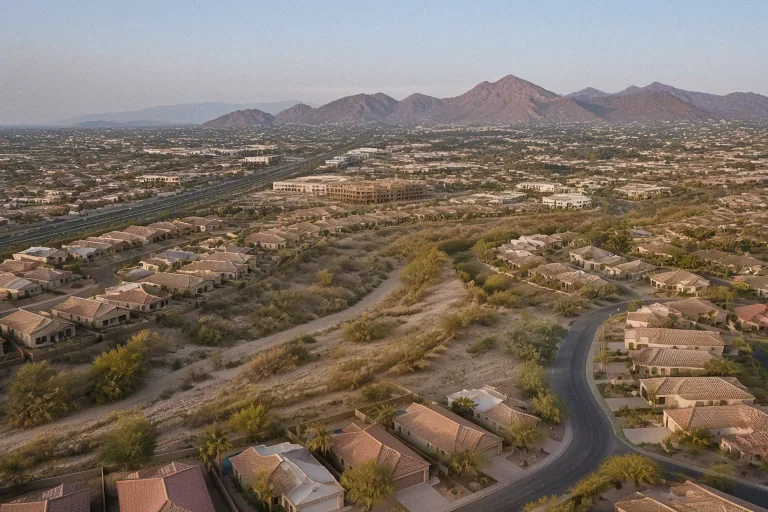
Tempe recorded 180,587 residents in the 2020 Census and includes dense residential, university, retail, and office areas near the Salt River Pima-Maricopa Indian Community. Concrete planning varies across older driveways, commercial approaches, and properties with mature landscaping, so the service scope may include installation, repair, resurfacing, replacement, sealing, or restoration. For projects spanning more than one Valley property, service also extends to Guadalupe, Mesa, Chandler, Scottsdale, Gilbert, and Phoenix.

Concrete Driveways

A worker uses a power trowel to smooth a wet concrete driveway at a job site in Tempe, AZ.

Concrete work can include residential and commercial driveways, patios, foundations, retaining walls, slabs, decorative finishes, and restoration. The recommended scope starts with the property's soil, drainage, access, use, and existing concrete condition.

Explore Service

Concrete Patios

Worker using a power trowel to smooth a wet concrete patio slab on a jobsite in Tempe, AZ.

New installation covers grading, base compaction, forming, reinforcement, concrete placement, finishing, and curing. The work is coordinated with City of Tempe permitting so a new driveway meets current requirements from the start.

Explore Service

Concrete Slabs

A worker uses a power trowel to smooth a wet concrete slab at a residential construction site in Tempe, AZ.

Driveways more than 15 years old often show cracks, spalling, or settlement near roots and irrigation lines. Repair options include epoxy or polyurethane crack injection, mudjacking or polyurethane foam lifting, and a bonded resurfacing overlay 1-2 inches thick when the underlying slab remains sound.

Explore Service

Concrete Foundations

Steel rebar cage on plastic chairs with wooden side forms for a concrete foundation in Tempe, AZ.

Maintenance options include concrete sealing, staining, polishing, and surface restoration. Sealing every 2-3 years helps a properly installed driveway retain a serviceable surface in Tempe's sun and dust.

Concrete Sidewalks

A worker uses a power trowel to finish a fresh concrete sidewalk at a job site in Tempe, AZ.

Replacement is appropriate when widespread cracking, heaving, or base failure cannot be corrected with a targeted repair. The old slab is removed, drainage or base problems are corrected, and a new driveway is poured; this is common with original 1970s-80s concrete that predates current reinforcement practices.

Concrete Walkways

Worker operating a power trowel to smooth a wet concrete slab at a residential job site in Tempe, AZ.

A site evaluation checks soil condition, existing drainage, slab damage, and equipment access. Those observations help distinguish a repairable crack or settled panel from a surface suited to resurfacing or a driveway that needs replacement.

Concrete Repair

A precision saw-cut groove prepared for concrete crack repair on a driveway in Tempe, AZ.

Residential driveways are planned for home access and expected vehicle loads, with finishes ranging from a broom texture to exposed aggregate. The source specification uses a minimum 4-inch slab at 3,000-4,000 PSI over compacted base, with control joints every 8-10 feet.

Stamped Concrete

Textured polyurethane mats stamping a pattern into colored concrete at a jobsite in Tempe, AZ.

Commercial entrances, parking approaches, and loading areas require concrete designed for heavier, more frequent traffic. Typical specifications call for a 5-6-inch slab at 4,000 PSI with reinforcement matched to expected loads, while pour timing can be coordinated around lower-traffic hours.

Concrete Pavers

Interlocking concrete pavers set in a sand bed at a residential landscaping project in Tempe, AZ.

For time-sensitive cracking, settlement, or damaged access areas, request an evaluation so the immediate condition and appropriate repair or replacement scope can be identified. Scheduling and site access are confirmed after the concrete and surrounding conditions are reviewed.

Commercial Concrete

Worker operating a power trowel on a wet concrete slab at a jobsite in Tempe, AZ.

Estimate visits consider soil, drainage, access, finish goals, and whether existing concrete can be repaired or resurfaced. With Loop 101, Loop 202, and US 60 crossing Tempe, crews can reach a Tempe address within the same working day for an estimate.

Driveway Planning

How to Choose a Concrete Driveway Approach

The right approach depends on the existing slab, underlying soil, traffic loads, drainage, finish goals, and placement conditions. A repair, overlay, panel replacement, or complete new pour should solve the actual failure mechanism rather than cover its symptoms.

Existing Slab Condition

Isolated cracks may be candidates for epoxy or polyurethane injection, and settled panels may respond to mudjacking or polyurethane foam lifting. Resurfacing fits a structurally sound but worn slab, while heaving or base failure points toward replacement.

Soil and Base Preparation

Hard caliche may require mechanical breakup during excavation, while clay in South Tempe can expand after monsoon saturation and contract during dry heat. Base preparation should respond to those site conditions instead of relying on a one-size-fits-all detail.

Slab Thickness and Load Demand

A residential driveway and a commercial loading approach do not carry the same loads. Slab thickness, concrete strength, and welded wire mesh, fiber mesh, or rebar should be selected for the vehicles and traffic expected on the finished surface.

Drainage and Grading

Monsoon season runs from June through September, making slope away from the garage and foundation essential. Existing runoff paths and finished grades should be resolved before forms are set.

Finish and Surface Care

Broom finish, exposed aggregate, integral color, saw-cut banding, and stamped patterns provide different appearances and maintenance considerations. Concrete also reflects more heat than asphalt, whose dark surface can exceed 140°F on a Tempe summer afternoon and requires resealing every 2-3 years to remain functional.

Hot-Weather Placement and Curing

When slab temperatures push past 100°F, early-morning placement, retarding admixtures, and immediate curing compound help slow moisture loss. A contractor's curing plan matters because rapid drying can leave surface crazing or a weak top layer.

Tempe Driveway Issues

Common Concrete Driveway Problems on Tempe Properties

Cracks, settlement, heaving, spalling, pitting, and poor drainage usually point to a combination of soil movement, base condition, heat, water, roots, or age. Identifying the cause helps determine whether the useful response is injection, lifting, resurfacing, panel replacement, or a full rebuild.

Request a Driveway Assessment

Expansive-Soil Cracking

Clay soil can swell when monsoon rain saturates it and contract during the dry summer. Without adequate base preparation and control joints, that movement can create cracks through the driveway.

Settled or Heaved Panels

Weak base areas, changing soil volume, or water beneath a slab can leave adjoining panels at different elevations. Lifting may correct a suitable settled section, but heaving or broader base failure can require replacement.

Spalling, Pitting, and Scaling

An older driveway may remain structurally sound while years of UV exposure leave the surface pitted, scaled, or discolored. In that situation, a bonded overlay can renew the surface without removing the entire slab.

Runoff Toward Structures

A driveway that directs monsoon runoff toward the garage or foundation can concentrate moisture at slab and building edges. Correct grade and drainage are essential parts of a durable repair or replacement plan.

Tree-Root and Irrigation Damage

Mature landscaping, tree roots, and irrigation lines near a slab edge can contribute to cracking or settlement. The nearby condition should be assessed before repairing a crack or replacing a panel.

Heat-Related Crazing

Concrete placed in intense heat can lose surface moisture before it develops adequate strength. Early-morning placement, adjusted set time, and immediate curing help reduce fine crazing and weak surface layers.

Why Choose Us

Why Choose Phoenix Concrete Co. in Tempe?

Phoenix Concrete Co. combines documented contractor credentials with planning tailored to Tempe soil, heat, drainage, and permitting. The team evaluates each lot, coordinates required city steps, and explains the curing and access timeline before the finished driveway is placed into service.

Licensed and Insured Contractor

Phoenix Concrete Co. is presented in the source as a licensed concrete contractor and an insured concrete contractor. That documented business foundation supports residential and commercial driveway planning.

Tempe Permit Coordination

The team handles City of Tempe permitting and coordinates Building Safety Division inspections for driveway installation. Property owners do not have to manage those project steps on their own.

Clear Curing and Access Guidance

Placement timing, low-traffic scheduling, curing protection, and return-to-use expectations are communicated as part of the project. That guidance helps homeowners and property managers avoid loading new concrete before it is ready.

Installation Process

Our Concrete Driveway Installation Process in Tempe

A driveway installation moves from site evaluation and preparation through forms, reinforcement, concrete placement, finishing, jointing, and protected curing. Each step is coordinated around soil, drainage, equipment access, finish requirements, and the loads the slab will carry.

01.

Site Visit and Scope

The first visit assesses soil condition, existing drainage, slab condition, equipment access, and finish goals. Those findings establish whether demolition is needed and how the new driveway should be graded and built.

02.

Demolition, Excavation, and Base

Existing concrete is removed when required, the area is excavated to depth, and hard caliche is broken up as needed. A granular base course, typically 4 inches of compacted aggregate, is prepared before forming.

03.

Forms, Grade, and Reinforcement

Forms are set to the intended grade and drainage slope. Welded wire mesh, fiber mesh, or a rebar grid is placed according to the application, and planned control-joint locations are established.

04.

Concrete Placement and Finish

Ready-mix concrete delivered to ASTM C94 standards is placed, screeded, floated, and finished to the specified texture. Hot-weather adjustments help preserve workable set time during placement.

05.

Control Joints and Curing

Control joints are cut within the first 6-12 hours so expected shrinkage has planned locations. Curing compound or wet curing protects the slab for a minimum of 7 days.

06.

Protection and Handover

The slab is protected from foot traffic for 24-48 hours and vehicle traffic for at least 7 days. Concrete reaches full design strength at around 28 days, and that timeline is explained before the driveway returns to normal use.

Project Goals

Concrete Driveway Outcomes for Tempe Properties

Case Study 1: Stable new installation: Soil-aware excavation, compacted base, load-appropriate reinforcement, drainage, and control joints work together to support a durable new driveway.

Case Study 2: Targeted correction: Crack injection, slab lifting, panel replacement, or base correction addresses the condition identified during the site evaluation.

Case Study 3: Renewed surface: A bonded overlay can restore a sound but weathered slab, while stamped, colored, aggregate, or saw-cut finishes provide a more customized appearance.

Plan Your Project

Plan Your Tempe Concrete Driveway Project

Share the condition of your existing driveway, the vehicles or traffic it needs to support, and the finish you have in mind. Phoenix Concrete Co. can evaluate the site and recommend repair, resurfacing, replacement, or a new installation based on the property's soil, drainage, and access.

Tempe Concrete Help

FAQs About Concrete Driveways in Tempe, AZ

These answers cover driveway lifespan, specifications, repair decisions, local soil and weather conditions, permitting, decorative finishes, service areas, and the return-to-use timeline.

Call About Your Driveway

A properly installed concrete driveway typically lasts 25-30 years. With regular sealing and appropriate care, some Tempe driveways remain serviceable past 50 years.

The source specification calls for a minimum 4-inch slab at 3,000-4,000 PSI over a properly compacted base. Control joints are cut every 8-10 feet to manage expected movement and shrinkage.

Commercial entrances, parking approaches, and loading areas carry heavier and more frequent loads. A typical commercial specification may use a 5-6-inch slab at 4,000 PSI with reinforcement selected for expected traffic.

Isolated cracks may be treated with epoxy or polyurethane injection, and settled sections may be lifted with mudjacking or polyurethane foam. Widespread cracking, heaving, or base failure is more likely to require panel replacement or a complete rebuild.

Resurfacing fits a driveway whose structural slab is sound but whose surface is pitted, scaled, or discolored. A bonded overlay 1-2 inches thick can renew the surface and may also support a decorative finish.

Hard caliche can complicate excavation, while clay in many South Tempe lots expands after monsoon saturation and contracts during dry summer conditions. Base compaction, drainage, reinforcement, and control-joint planning should respond to the actual lot conditions.

When slab temperatures push past 100°F, the installation plan can use early-morning placement and retarding admixtures to slow set time. Immediate curing compound helps keep surface moisture from flashing off too quickly.

Tempe's monsoon season runs from June through September and can bring heavy runoff. The driveway should be graded so water moves off the slab and away from the garage and foundation.

The slab should be protected from foot traffic for 24-48 hours and from vehicle traffic for at least 7 days. Concrete reaches full design strength at around 28 days.

The process starts with a site visit, followed by any needed demolition, excavation, base compaction, forms, grade, and reinforcement. Ready-mix concrete is then placed, finished, jointed, and protected through curing.

Yes. The source states that Phoenix Concrete Co. coordinates City of Tempe permitting and Building Safety Division inspections for driveway installation.

Options named in the source include exposed aggregate, integral color, saw-cut banding, and stamped concrete. Stamped patterns include cobblestone, ashlar slate, and running-bond brick.

Ready-mix concrete is delivered to ASTM C94 standards. The installation approach also follows American Concrete Institute guidance on curing and jointing along with City of Tempe drainage requirements.

Service covers Tempe areas near Arizona State University and Tempe Town Lake, South Tempe, the Kyrene corridor, Warner Ranch, and Ocotillo. The source also names Guadalupe, Mesa, Chandler, Scottsdale, Gilbert, and Phoenix.

The source states that crews can reach any Tempe address within the same working day for estimates. Project scheduling is confirmed after the site conditions, access, and requested scope are reviewed.